

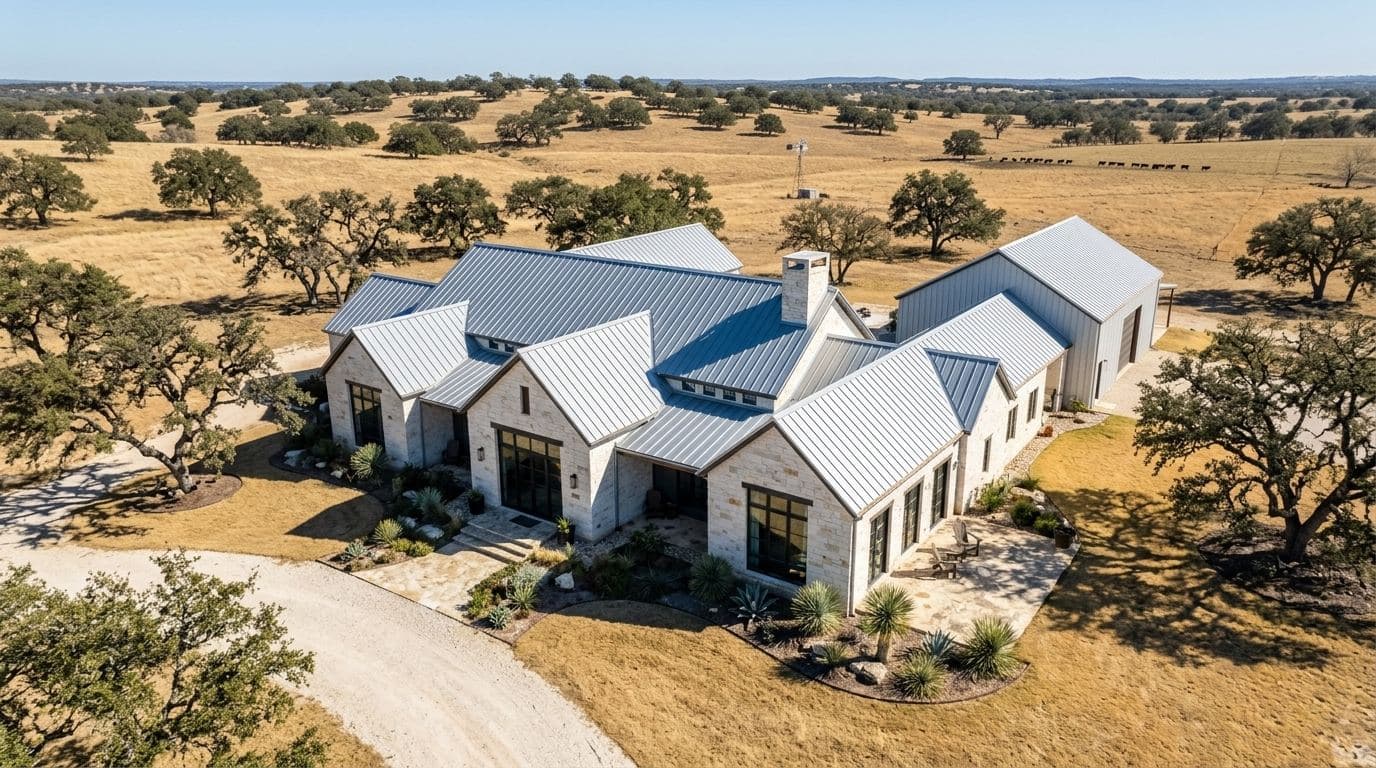
- Snow guards are a safety detail, not a performance upgrade — they control where shed snow lands, not whether the roof works.
- They matter far more on metal than on asphalt. A shingle roof's texture holds snow in place; a smooth standing seam panel is built to let it go.
- In North Idaho the question is almost never *whether* — roof snow minimums run 40 psf on the Rathdrum Prairie to 70 psf in Bonners Ferry. It is *where and how many*.
- The non-negotiable locations are anywhere a person, a vehicle, or a gas meter sits below a shedding slope.
- Layout is engineered to your roof's pitch, panel length and load — not bought by the box. Guards placed only at the eave are the most common and most expensive mistake.
What a snow guard actually does
A snow guard is a small bracket or a continuous bar fixed to the roof surface that interrupts a sliding snowpack. On a smooth metal panel, snow does not melt away in place the way it does on asphalt — it warms slightly at the deck, loses its grip, and releases as a single sheet. On a 12/12 pitch that sheet can weigh several hundred pounds and travel like an avalanche.
Guards break that event up. Instead of one release, the snow comes off in smaller increments over hours or days, or melts and drains as water. The roof still sheds — that is the whole point of metal in snow country — but it sheds on terms you chose.
What snow guards are **not**: they are not a fix for an undersized roof structure, and they are not a substitute for correct snow-load engineering. Holding more snow on a roof increases the load that roof carries. That is a structural question for your parcel, which is why layout is engineered rather than eyeballed.
Why metal needs them and shingles usually do not
Asphalt shingles have a granular surface that grips snow. Snow accumulates, sits, and mostly melts in place — which is also why shingle roofs in this region form ice dams: meltwater runs down to the cold eave, refreezes, and backs up under the courses until it finds a seam.
Standing seam solves the ice-dam problem by refusing to hold the snow in the first place. The trade is that the snow has to go somewhere. On a rural parcel with open ground below every slope, that is often fine and no guards are needed. On a house where the main slope discharges over the front door, it is not.
Roof snow loads by town — North Idaho and Spokane County
These are the roof-load minimums local building departments design to. They set how much weight a guard layout has to resist, and they vary sharply over short distances — Hayden alone changes requirement on either side of Miles Avenue.
| Town / jurisdiction | Roof snow minimum | What it means for guards |
|---|---|---|
| Bonners Ferry (Boundary Co.) | 70 psf | Highest city minimum in our network — heaviest guard duty |
| Unincorporated Bonner Co. / Schweitzer | 70 psf and up | Parcel-specific; the county snow-load map governs, elevation-driven |
| Sandpoint (Bonner Co.) | 55 psf | Ice-barrier underlayment also required by code |
| Hayden — north of Miles Ave | 50 psf | Load steps up with elevation |
| Hayden — south of Miles Ave | 40 psf | Same city, different requirement |
| Coeur d'Alene (Kootenai Co.) | 40 psf | Higher toward the eastern foothills |
| Post Falls (Kootenai Co.) | 40 psf | Rathdrum Prairie floor |
| Spokane / Spokane Valley, WA | ~30 psf | Lower minimum, but higher ground north and east of the city |
Where snow guards are non-negotiable
- **Over any entry door** — the single most common cause of injury from a shedding roof.
- **Over walkways, steps and decks** — including the path from the driveway most people actually use in winter.
- **Above gas meters, propane tanks and utility connections** — a released slab can shear a meter off a wall.
- **Over driveways and parking pads** — where a vehicle sits under a slope for hours at a time.
- **Above HVAC equipment, heat pumps and mini-split condensers.**
- **Where a lower roof catches a higher slope** — snow dumped from an upper roof concentrates load on the lower one and can exceed what it was designed to carry.
- **Along a property line** where shed snow would land on a neighbour's ground.
Pad-style versus continuous bar
Pad-style (sometimes called cleat or fence-style) guards are individual brackets set in a staggered pattern across the slope. They are lighter, less visible, and generally suited to shorter panel runs and moderate loads.
Continuous-bar systems run one or more horizontal rails across the slope on clamped brackets. They distribute load along the whole run rather than at points, and in high-load country like Bonner and Boundary County they are frequently the correct answer rather than the upgrade.
On a true standing seam roof, both attach with **non-penetrating clamps that grip the seam** — nothing is screwed through the panel. This matters: any guard system that requires drilling the weather surface of a standing seam roof introduces the exact failure point the roof exists to avoid. On exposed-fastener panels the attachment method differs, and that is one of several reasons the two systems are not interchangeable in snow country.
How many, and where on the slope
The honest answer is that it is calculated, not guessed. The inputs are roof pitch, panel length from ridge to eave, the design snow load for your parcel, the panel profile, and the seam type the clamps have to grip. A 12/12 slope with a 40-foot run in Bonners Ferry and a 4/12 slope with a 16-foot run in Post Falls are not the same problem.
The most common mistake is a single row of guards at the eave. All of the sliding force in the entire slope arrives at that one row, which is both the least effective place to resist it and the most likely to fail. Correct layouts distribute rows up the slope so the load is broken into manageable pieces.
Your local Metal Roof Expert engineers the layout to the parcel and the panel being installed. If someone quotes you snow guards by the linear foot without asking your pitch or your panel length, that is a signal worth noticing.
What they cost, and when they are already included
Snow guards are a modest line against the roof itself — typically a low single-digit percentage of a standing seam project, driven by how many slopes actually need protection rather than by the roof's total size. A house that needs guards over one entry and a driveway costs far less to protect than one where every slope discharges over something.
On our satellite quotes, snow retention is called out separately rather than buried in a per-square number, and whether it is recommended at all is confirmed at the on-site assessment — because it depends on what is underneath each slope, which no satellite image can tell you. Two identical roofs on the same street can need completely different guard layouts based on where the front walk runs.